Camper Rental Marketing: Where to Get Clients
A good camper rental company is not just about the fleet and pricing, but also about how the customer finds you in the first place. There are several channels, and each operates differently: some provide quick traffic but take away your margin, while others build up over months but bring in returning customers. Below is the order of what is worth utilizing and how CamperFleet helps to connect it all.
Three types of channels
- External places: intermediary portals, OLX, Facebook groups. The client is already there, and you join their space.
- Paid advertising: Meta (Facebook and Instagram) and Google Ads. You pay for the traffic that you specify yourself.
- Own channels: reservation website, search engine, email and SMS to existing clients. You build them more slowly, but they remain yours.
A sensible strategy combines all three: the first clients come from external places, and each subsequent rental is conducted in such a way that the client returns to your own website.
Intermediary Portals
Camper portals are marketplaces where owners list their vehicles, and customers select and book them. In Western Europe, this is an established market: Goboony is merging into Yescapa, and the combined brands are referred to as the largest camper sharing platform in Europe (Motor1, Goboony). Other players in the market include Camplify, Outdoorsy, PaulCamper, and Indie Campers.
What we don't know: There is no public, reliable data on how many bookings in Poland go through each portal. The scale and popularity vary by regions and seasons, so instead of guessing, check it for yourself (see the section on measurement).
Advantages: ready traffic and customer trust, especially from those who do not yet know your company, as well as often a ready payment process and support. Disadvantages: commission on bookings (check the amount in the terms of the specific portal), external rules, and the fact that the customer belongs to the portal, not to you.
More: Camper portals vs. own website.
How CamperFleet supports you: you don't have to choose between a portal and your own website. Bookings from portals come to CamperFleet automatically (each portal has your email address in CamperFleet), and occupied dates return to the portals — through a calendar link or a task list to "block dates." The camper can be everywhere without the risk of double booking. See How to avoid double bookings.
OLX
OLX is one of the largest classifieds platforms in Poland, with millions of users monthly. Camper rental companies have their own category there (Rental, Cars and Vehicles, Campers). There is no separate public data on traffic for camper rental listings, but for many rental companies, it is the simplest way to get customers from the local area.
Advantages: high local traffic, quick start, and direct contact with the customer, no commission on bookings (OLX has its own rules regarding packages and ad limits).
Disadvantages: there is one price in the listing (OLX does not support seasonal pricing), there is no availability calendar, and customers ask the same questions. Phone numbers and email addresses cannot be provided in the content.
How it supports CamperFleet: builds a listing from vehicle data (description, equipment, seasonal pricing in the content, additions), allows editing, and helps respond to inquiries as the assistant checks availability in the calendar and prepares a draft response for approval.

Details: Camper listing on OLX with CamperFleet.
Facebook Groups
Camper and traveler groups are places where people ask for recommendations and share experiences. The number and size of such groups vary, and there is no single reliable source that could count them for camper rentals, so we do not provide numbers.
Advantages: recommendations from people who have already traveled and trust in a specific person rather than an impersonal brand. Disadvantages: many groups prohibit advertising or limit it to selected days, messages quickly disappear in the feed, and answering the same questions takes time.
Best practices: read the group rules before posting anything. Be helpful, not pushy: answer questions and only then link to your site. Establish a single place you always lead to (your booking page address) so the client doesn’t have to search.
How CamperFleet supports you: you receive a ready-made advertisement text built from vehicle data that you can copy to your post, and clients who come from the group to your site can immediately ask about availability and pricing in the chat. See Chat on the rental website. CamperFleet does not publish posts in the groups for you.
Meta and Google Ads
These are standard paid advertising mechanisms that work the same way in every industry:
- Meta (Facebook and Instagram): you build audience groups (e.g. people from Tri-City interested in travel), show them pictures and videos of campers, and drive traffic to your website. Remarketing works well, reminding those who visited your site but did not make a reservation.
- Google Ads: you pay for clicks from people who are actively searching, e.g. "camper rental Gdańsk." Such people are usually close to making a decision, so the traffic is more valuable, but also more expensive.
Advertising makes sense only when you know how much one reservation costs you. That's why measurement is important.
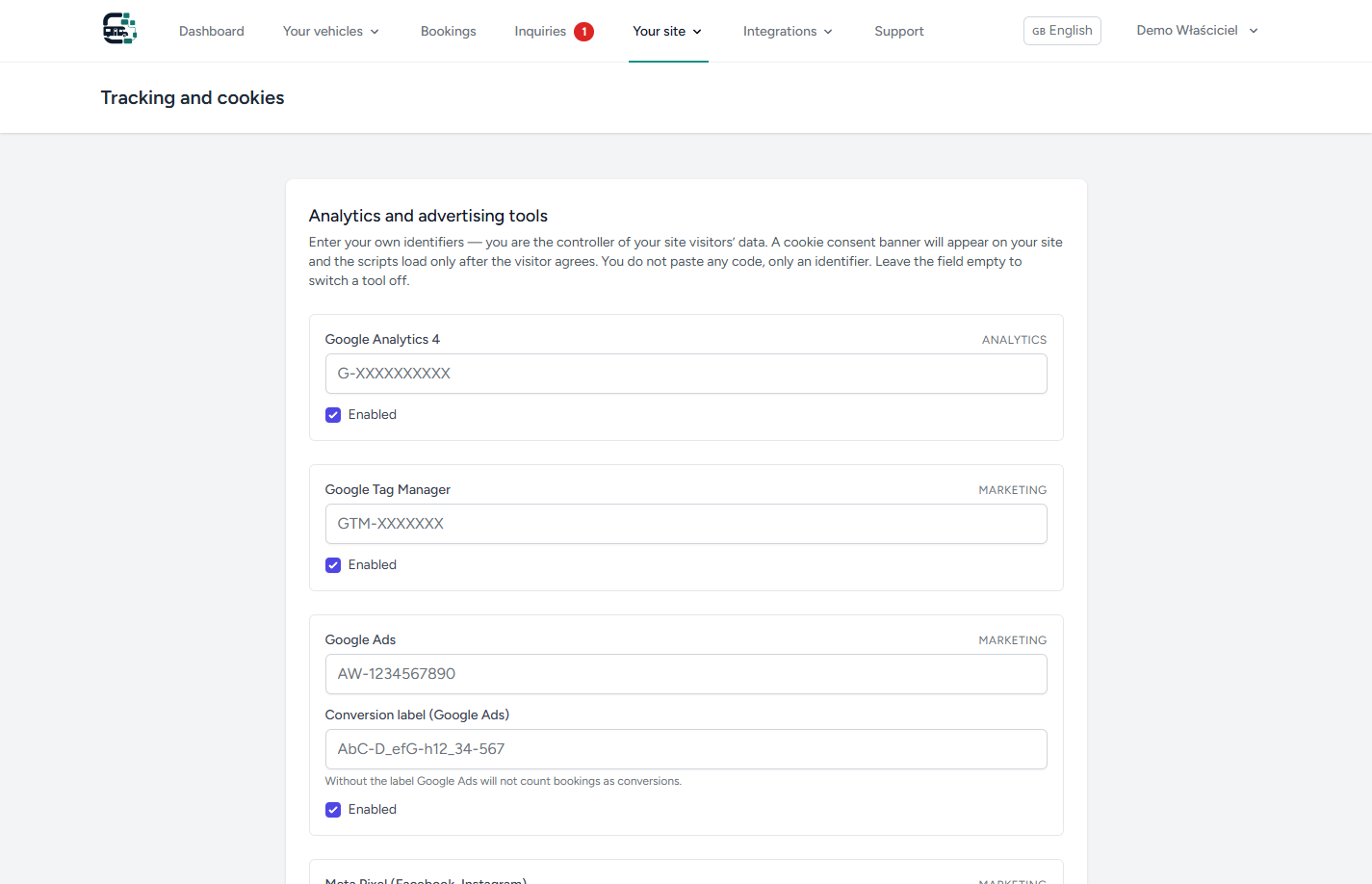
How CamperFleet supports you: in the tracking settings, you enter your own identifiers for Meta Pixel, Google Analytics 4, Google Tag Manager, and Google Ads (along with the conversion tracking tag). You do not paste any code. The website shows a cookie consent banner, and the scripts load only after the visitor gives consent. We report completed reservations (with amount and currency) as a conversion, once per reservation and without client data. Additionally, you receive a privacy policy generator that automatically updates the sections regarding enabled tools (this is a starting template, not legal advice).
Own website and customer contact
This is the slowest growing channel, but it remains yours:
- Online booking page under your brand and domain, with a title and description for search engines, a sitemap (
sitemap.xml), and your own subpages or articles (e.g. guide for beginners). - Multilingualism: vehicle descriptions, FAQs, and texts are automatically translated into the guest's language, so tourists from Germany read and book in German.
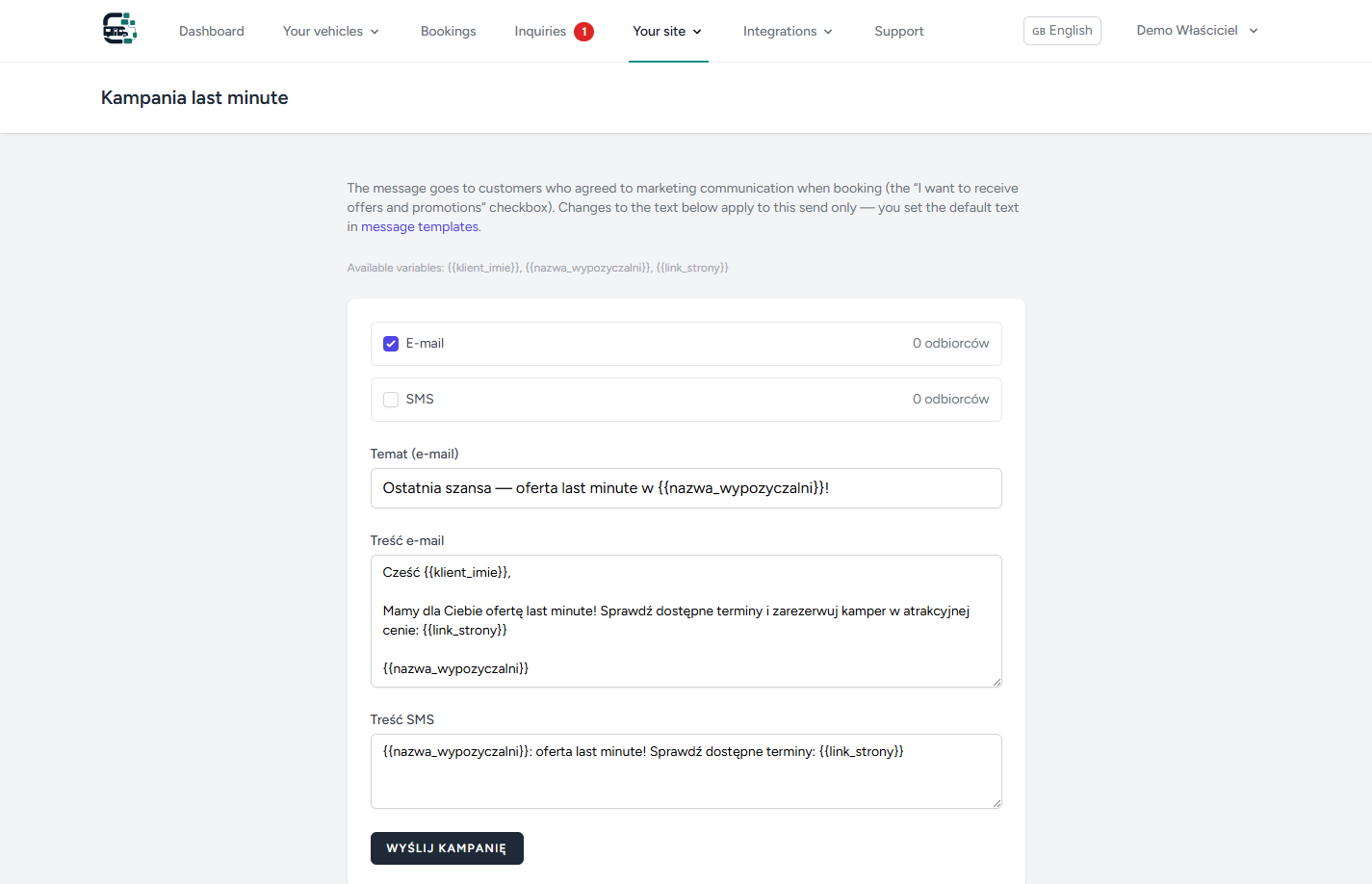
- Customer returns: at the time of booking, the customer can give marketing consent, and you send these people a last-minute campaign (email, and SMS after connecting the gateway) for available dates.
Channel Comparison
| Channel | Cost | Customer Control | What CamperFleet Provides |
|---|---|---|---|
| Mediating Portals | commission from bookings | low | calendar synchronization, import bookings from emails |
| OLX | packages and ad limits | average | ad based on vehicle data, editor, response assistant |
| Facebook Groups | time | average | ready-made ad text, chat on your website |
| Meta and Google Ads | advertising budget | high | pixels, GA4, Google Ads, cookie consent |
| Own website and email | subscription | full | online bookings, last-minute campaigns, multilingual support |
How to check what works for you
Since there is no good data for the entire market, measure your own:
- Ask customers: “Where did you hear about us?” with every reservation and record the answer.
- Use separate links with UTM tags in ads and posts, and connect Google Analytics 4 in your website settings.
- Count advertising conversions: with the connected Meta Pixel or Google Ads, you will see how many reservations the ad generated.
- After the season, calculate the cost of a single reservation from each channel: commissions, fees, and advertising expenses divided by the number of reservations.
Based on this, you can shift the budget and time to where the reservation costs the least.